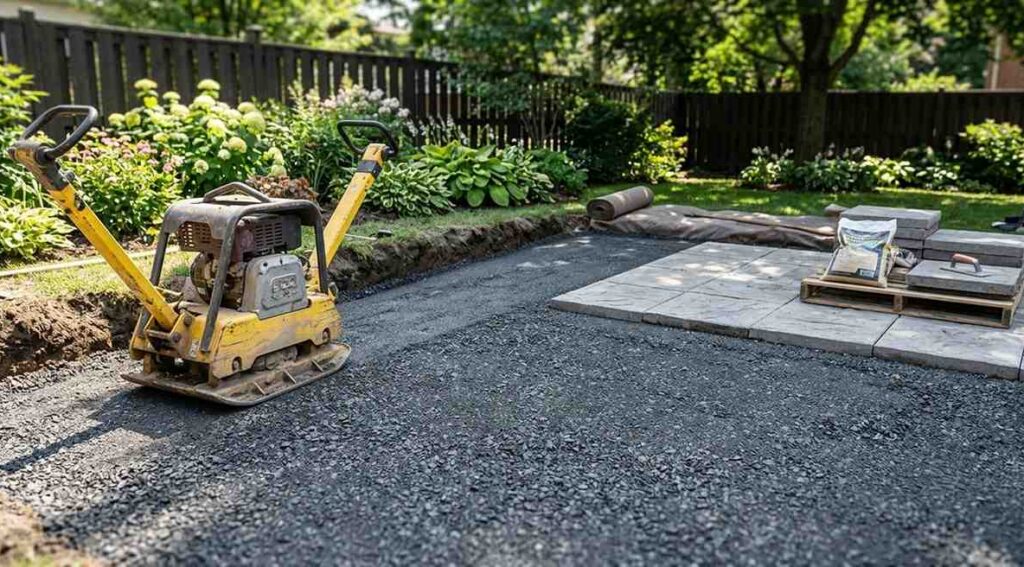
When the Anchorage summer finally arrives, Alaskans want to spend every possible moment outside soaking up the midnight sun. A beautiful new backyard patio seems like the perfect project—a place to fire up the grill, host friends, and enjoy the short, sweet summer.
But there is a heartbreaking scenario that plays out in backyards across Southcentral Alaska every spring. Homeowners invest thousands of dollars into gorgeous paving stones or stamped concrete, only to watch their dream patio turn into a wavy, sunken, cracked mess after a single Alaskan winter.
The culprit? It’s almost never the pavers themselves. The failure lies entirely beneath the surface.
If you are planning an outdoor upgrade this year, whether you live in Eagle River or on the Anchorage Hillside, understanding what happens under your patio is the most important part of the project. Let’s explore why proper site compaction is absolutely non-negotiable in Alaska, the destructive power of frost heave, and how professional site work protects your hardscaping investment.
What is Site Compaction?
In the landscaping and construction world, compaction is the process of applying heavy mechanical pressure to soil or gravel to remove the empty air pockets (voids) between the particles.
When dirt is naturally deposited or newly excavated, it is loose and full of air and moisture. If you simply lay a heavy stone patio on top of loose dirt, gravity and natural settling will eventually compress the earth underneath it. Because soil naturally settles unevenly, your patio will sink in random spots, creating a hazardous, bumpy surface.
Proper compaction artificially accelerates this settling process before anything is built on top, creating an unyielding, rock-solid foundation that will not shift under the immense weight of stone, concrete, or winter snow loads.
The Alaskan Threat: Frost Heave and Glacial Till
Building a patio in the Lower 48 is vastly different than building one in Anchorage. We battle two unique geological challenges that make site compaction exponentially more critical here than in warmer climates.
1. The Destructive Force of Frost Heave
As the ground freezes during an Anchorage winter, the moisture trapped within the soil expands. This expansion pushes the earth upward with incredible force—a process known as frost heave. When the spring breakup arrives, the ground thaws and contracts.
If the soil beneath your patio wasn’t properly compacted and mixed with the right draining base materials, it holds excess water. When that water freezes and heaves, it acts like a jackhammer on your patio from below. It easily lifts heavy pavers, shatters concrete slabs, and completely destroys the level surface.
2. Unpredictable Native Soils
The native soil in the Anchorage Bowl is largely glacial till—a chaotic mix of silt, clay, and rocks. Clay, in particular, is terrible for patios because it acts like a sponge, retaining the exact moisture that fuels frost heave. You cannot simply compact native Anchorage clay and build on it. Professional residential site work involves removing this problematic native soil entirely and replacing it with engineered materials.
(To understand the extreme forces at play beneath your lawn, the University of Alaska Fairbanks (UAF) Cooperative Extension offers great resources on how frost heave impacts Alaskan structures.)
What Happens When You Skip Proper Compaction?
Trying to save money by rushing the base preparation is the most expensive mistake a homeowner can make. If your landscape contractor skips proper compaction, you will experience the following failures:
- Tripping Hazards: As the ground settles unevenly, individual pavers will sink or jut upward, turning a smooth walking surface into a dangerous tripping hazard for your family and guests.
- Pooling Water and Ice: A sunken patio acts as a bowl. Instead of shedding rainwater away from your home, it collects in the center. In the late fall, these puddles freeze into sheets of slick ice, completely ruining the usability of your outdoor space.
- Foundation Threats: If the patio settles in a way that slopes back toward your house, you have just created a massive drainage problem. Water will run directly into your foundation, leading to flooded basements and requiring emergency grading intervention.
- Weed Invasions: When pavers shift and separate, it opens up the joint sand. Seeds blow in, and soon your beautiful hardscape is overgrown with stubborn Alaskan weeds and moss.
The Professional Patio Prep Process
To build a patio that survives decades of Anchorage winters, contractors must follow a strict, multi-step earthmoving process. Here is how it should be done:
Step 1: Deep Excavation
A professional crew will dig down far below the surface level—typically 7 to 12 inches, depending on the native soil and the thickness of the pavers. All roots, organic material, and clay-heavy topsoil must be entirely removed from the site.
Step 2: Subgrade Compaction and Fabric Layering
Before any new material is brought in, the exposed native earth (the subgrade) is heavily compacted. Then, commercial-grade geotextile fabric is laid down. This crucial barrier prevents the heavy base gravel from sinking and mixing into the muddy Alaskan subsoil during the spring thaw.
Step 3: Installing the Aggregate Base
Next, a thick layer of crushed angular gravel (commonly referred to in Alaska as D-1 or Type II gravel) is brought in. Unlike smooth river rock, crushed gravel has sharp edges that interlock tightly together when compressed.
Step 4: Compacting in “Lifts”
You cannot dump 6 inches of gravel and compact it all at once; the machine’s energy won’t reach the bottom. Professionals compact the base in “lifts,” laying down 2 inches of gravel, running a heavy vibratory plate compactor over it, and repeating the process until the desired height is reached.
Step 5: Final Screeding
Finally, a thin 1-inch layer of coarse bedding sand is laid and perfectly smoothed (screeded). This gives the heavy pavers a flat bed to sit on. Once the patio is laid, a compactor with a protective pad is run over the stones one last time to lock everything permanently into place.
(This multi-step base preparation is recognized as the industry gold standard by the Interlocking Concrete Pavement Institute (ICPI), the leading authority on hardscape construction.)
Why You Can’t Just Use a Hand Tamper
Many enthusiastic DIYers attempt to build a patio over a long weekend, using a $40 steel hand tamper from a local hardware store to compact their base.
In a forgiving climate, you might get away with it. In Alaska, you won’t.
Human strength cannot generate the thousands of pounds of centrifugal force required to lock angular gravel together and squeeze out the voids. Professional hardscaping companies use heavy machinery—such as reversible vibratory plate compactors and trench rollers—to achieve a 95% to 98% compaction density. Without this heavy equipment, your base remains loose, and your patio is guaranteed to sink during the first spring breakup.
Protect Your Outdoor Investment
A custom patio should be a permanent extension of your home, adding significant property value and drastically improving your summer quality of life. But a stunning residential landscape design & install is only as good as the dirt it sits on.
Don’t let a rushed foundation destroy your hardscaping dreams. At Alaska Landworks, we approach patio construction from the ground up. Our experienced crews utilize state-of-the-art excavation equipment and heavy-duty compactors to build unyielding bases specifically engineered for the brutal Anchorage freeze-thaw cycle.
Ready to build a patio that actually lasts? Contact Alaska Landworks today to schedule your summer hardscaping consultation!
Frequently Asked Questions (FAQs)
How deep should the gravel base be for a patio in Anchorage?
For standard pedestrian patios (no vehicles), you need a minimum of 4 to 6 inches of compacted crushed gravel base. If the native soil is exceptionally poor or clay-heavy, contractors may excavate even deeper to create a thicker, more stable foundation.
Can I build a patio right over my existing lawn if I level it with sand?
Absolutely not. Topsoil and grass are full of organic matter that will eventually rot and decompose, leaving empty voids under your patio. Furthermore, sand does not compact; it shifts. You must excavate down to the subsoil and build a structural gravel base.
What is the best type of gravel to use for a patio base in Alaska?
The industry standard in Alaska is commonly referred to as “D-1” or Type II crushed aggregate. This is an engineered mix of crushed rock and stone dust ranging from 3/4-inch down to fine powder. When compacted and slightly dampened, it locks together almost like concrete.
How long does it take for a patio base to settle?
If a patio base is properly mechanically compacted during installation, it is fully settled immediately. You do not need to “wait a season” before laying the stones. If you have to wait for it to settle naturally, it was not installed correctly.