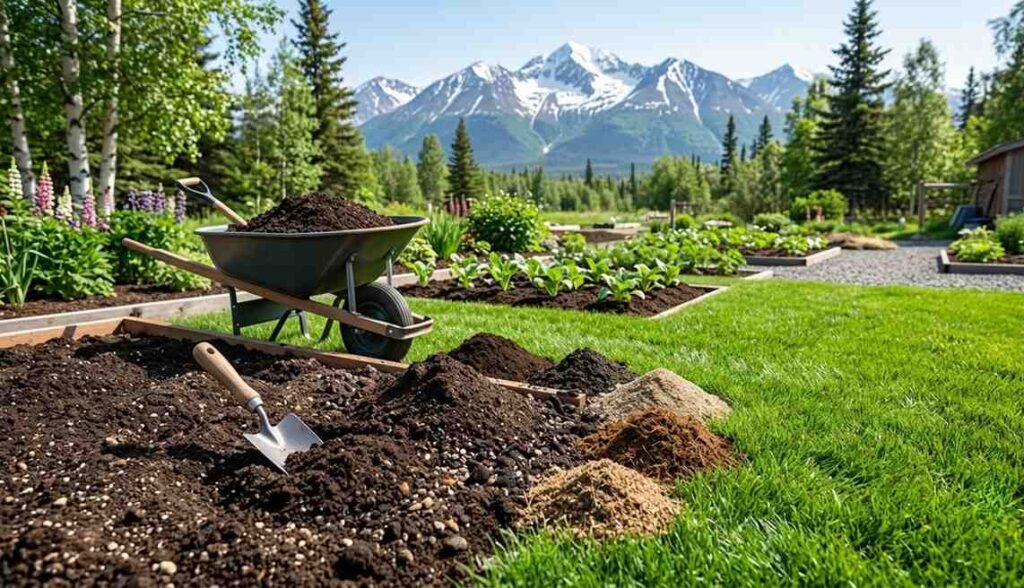
When the Anchorage summer finally arrives and the midnight sun is out, there is nothing quite like a lush, green lawn or a thriving garden. But as any Alaskan green thumb will tell you, achieving that vibrant landscape is an uphill battle.
The biggest hurdle? The ground beneath your feet.
Native soil in Southcentral Alaska is notoriously difficult to work with. It is often a frustrating mix of glacial till, heavy clay, and endless rocks, heavily lacking the organic nutrients required to grow a healthy lawn or productive garden. If you want your property to thrive during our short, intense growing season, you cannot rely on what is naturally there. You have to bring in the good stuff.
But not all dirt is created equal. Whether you are patching a sunken yard in Eagle River or building raised beds in South Anchorage, choosing the right soil blend is critical. Let’s break down the best topsoil mix for Anchorage properties, the difference between lawn and garden dirt, and how to set your landscape up for long-term success.
The Problem with Native Anchorage Soil
To understand why you need high-quality topsoil, you first need to understand what you are trying to cover up.
Much of the soil in the Anchorage Bowl and surrounding areas is “glacial till”—the unsorted sediment left behind by retreating glaciers thousands of years ago. While it provides a highly stable base for construction, it is terrible for agriculture.
Here are the three main issues with our native soil:
- It is incredibly rocky. If you’ve ever tried to dig a simple fence post hole in Anchorage, you know you will hit a softball-sized rock within the first three inches.
- It drains poorly: Areas heavy in clay trap water, creating those infamous soggy, sunken yards during the spring breakup.
- It is often highly acidic: Conifer needles (like those from spruce trees) drop and decompose, lowering the soil’s pH level. Most lawn grasses and garden vegetables prefer a neutral pH to absorb nutrients properly.
This is why proper residential site work always involves bringing in fresh, nutrient-dense soil before any planting begins.
Screened vs. Unscreened Topsoil: What’s the Difference?
If you start calling around for “dirt,” you will quickly be asked if you want screened or unscreened topsoil.
Unscreened topsoil is the raw earth excavated directly from a site. It contains roots, clumps of clay, and plenty of rocks. While it is cheaper and works fine as a deep structural fill material for changing the elevation of a yard, you should never try to plant a lawn directly on it.
Screened topsoil is dirt that has been sifted through a heavy-duty mesh (usually a 1/2-inch or 3/4-inch screen). This process removes the rocks, sticks, and large clumps, leaving behind a smooth, fine, and workable soil. If you are planting grass or a garden, screened topsoil is an absolute non-negotiable requirement.
The Perfect Topsoil Mix for Alaskan Lawns
Grass roots require three things to survive a harsh Alaskan winter: oxygen, proper drainage, and stability.
If your soil is too dense, the roots suffocate and drown. If it’s too loose and full of compost, the ground will act like a sponge, retaining too much water, freezing, and becoming highly susceptible to frost heave.
For Anchorage lawns, the ideal foundation is a Sandy Loam Mix.
Loam is the gold standard of soil, traditionally comprising roughly 40% sand, 40% silt, and 20% clay. For a lawn application in Alaska, a slightly higher sand content (around 50-60%) is incredibly beneficial.
- Why Sand? Sand prevents the soil from compacting under the weight of winter snow. It ensures rapid drainage so that during the heavy spring melt, water passes through the root zone rather than suffocating the grass.
- Why minimal compost? While a small amount of organic matter (compost or peat) is good for initial nutrients, a lawn mix shouldn’t exceed 10-15% organic material. As compost breaks down over time, it shrinks, which will cause your perfectly level lawn to become bumpy and uneven.
When you order high-quality residential topsoil for a new lawn, you are getting a finely screened loam base that provides the perfect balance of drainage and structural integrity. This is especially vital if you plan on hydroseeding, as the seed slurry needs a smooth, weed-free surface to grab onto and germinate.
The Perfect Topsoil Mix for Anchorage Gardens and Raised Beds
While your lawn needs stability and drainage, your vegetable gardens and flower beds are hungry for nutrients. Because you aren’t walking on your garden beds, structural compaction isn’t a concern.
For raised beds and garden plots, you want a Rich Organic Mix (often a 50/50 blend).
This typically consists of 50% screened topsoil (for bulk and mineral content) and 50% high-quality, aged compost.
- The Role of Compost: Compost acts as a slow-release fertilizer. It teems with beneficial microbes that break down nutrients into a form that plants—like heavy-feeding Alaskan cabbages, potatoes, or peonies—can easily absorb.
- Moisture Retention: Unlike your lawn, where you want water to drain quickly, your raised beds need to retain moisture during the hot, dry stretches of July. Organic matter holds water like a sponge, keeping roots hydrated longer.
(For detailed information on testing your specific soil’s pH and nutrient levels, the UAF Cooperative Extension Service offers excellent localized resources for Alaskan gardeners.)
Does This Apply to Commercial Properties?
Absolutely. In fact, due to the heavy foot traffic and massive snow loads pushed onto the landscaping of commercial lots, starting with the right soil is even more critical.
If you manage a business property or retail center, investing in premium commercial topsoil ensures that the grass in your median strips and the shrubs near your entrance survive the winter. Poor soil on a commercial lot leads to dead landscaping, which directly impacts your business’s curb appeal during the peak summer tourist season.
How Much Topsoil Do I Need?
Figuring out the volume of soil The volume can be tricky, as topsoil is measured and delivered in cubic yards.
As a general rule of thumb for Anchorage yards:
- For a new lawn: You want a minimum depth of 4 to 6 inches of quality screened topsoil over your subgrade.
- For garden beds: You want 8 to 12 inches of a nutrient-rich garden mix.
To calculate cubic yards: Multiply the length of the area by the width to get the square footage. Then, multiply that by the depth (in feet) and divide by 27.
Example: A 20 ft x 20 ft yard = 400 sq ft. To add 4 inches (0.33 feet) of soil: 400 x 0.33 = 132 cubic feet. 132 / 27 = roughly 5 cubic yards.
Stop Shoveling Dirt Out of Your Truck Bed
Buying bags of topsoil from a big-box store is fine for a single houseplant, but trying to cover a lawn that way will cost you a fortune. Even borrowing a friend’s pickup truck to haul half a yard of dirt at a time will quickly ruin your weekend and your back.
For any landscape project larger than a single flowerbed, bulk delivery and professional spreading are the only way to go.
At Alaska Landworks, we provide premium, locally screened topsoil perfectly formulated for the unique challenges of the Anchorage climate. From delivering a few yards for your garden boxes to comprehensive site grading and spreading for a brand-new lawn, our heavy equipment makes quick work of your summer projects.
Ready to build a greener yard? Contact Alaska Landworks today to schedule your topsoil delivery and landscape prep!
Frequently Asked Questions (FAQs)
What is the difference between topsoil and compost?
Topsoil is the uppermost layer of the earth, containing a mix of sand, silt, clay, and minerals; it provides structural support for roots. Compost is decayed organic matter (like leaves, food scraps, and manure) used strictly as a nutrient additive. Plants cannot grow in 100% compost; they need the structural base of topsoil.
Why is my Anchorage lawn so bumpy?
Bumpy lawns are usually caused by a freeze-thaw cycle acting on poorly drained, clay-heavy native soil or by the slow decomposition of buried organic debris (like stumps or roots). Reshaping the yard with proper sandy loam topsoil solves this issue.
Can I plant grass seed directly on my existing dirt?
In Anchorage, planting directly on native glacial till is rarely successful. The soil is too rocky and compacted for roots to establish, and it lacks the nutrients grass needs to survive the winter. You should always spread at least 4 inches of screened topsoil before seeding or hydroseeding.